
Superior teaching skills. Extremely helpful and unique that
the teacher, Jim Meadows, wrote the books."
UNIVERSITY OF WISCONSIN-MILWAUKEE

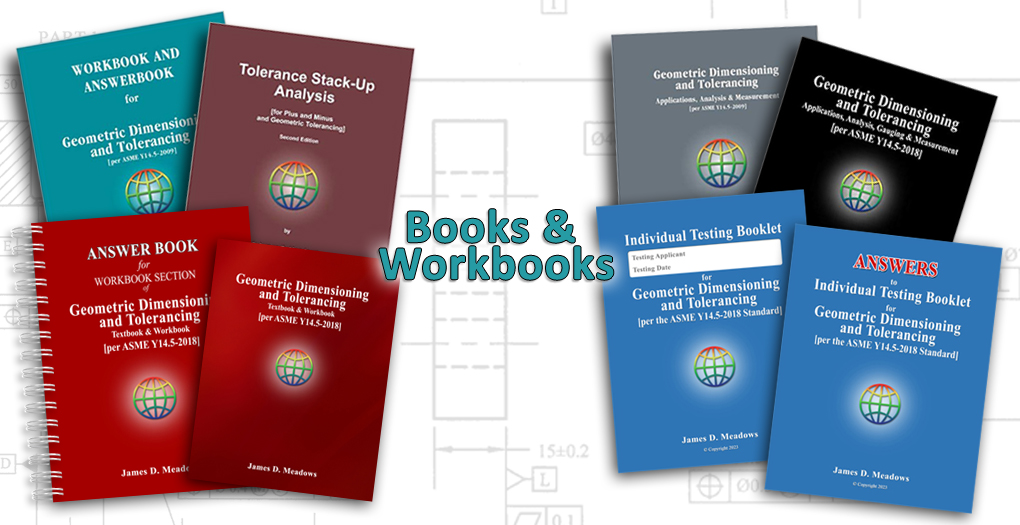
Textbook, workbooks, tests and reference materials, all you need to learn about essential dimensioning and tolerancing principles, including instructional GD&T books and GD&T DVD products. Many of these books and tests are written to comply with the newest ASME Y14.5-2018 standard on Dimensioning and Tolerancing. For details, see Store page
We now offer training courses in GD&T, Advanced GD&T, Tolerance Stack-Up Analysis and the Design, Dimensioning and Tolerancing of Gages and Fixtures live at your computer through Zoom!
During these times when travel, gathering in a real classroom or just having a discussion at close range is either not feasible or not wise, James Meadows will hold your training on-line through Zoom.
It is as effective as in-person training and presented in exactly the same format. We ship you the training materials in advance of the course, then on training days you just sign into the meeting while sitting at your workstation. You can listen to the lessons, see the examples, work through the problems and ask Jim Meadows any questions you have in real time.
Regular classroom hours are held. Lunch time is honored. Breaks are given. And, when each day is over, you are free to go back to work or go home as usual.
If you are interested in scheduling an on-line Zoom training session for your company, military base or university, please contact us at (615)924-3600, or email Jim at jamesmeadows@comcast.net or JDMeadows@geotolmeadows.com.
Both of these programs are structured to allow students to participate by completing applications-based problems throughout the courses. Self-teaching/classroom use or site licenses available.
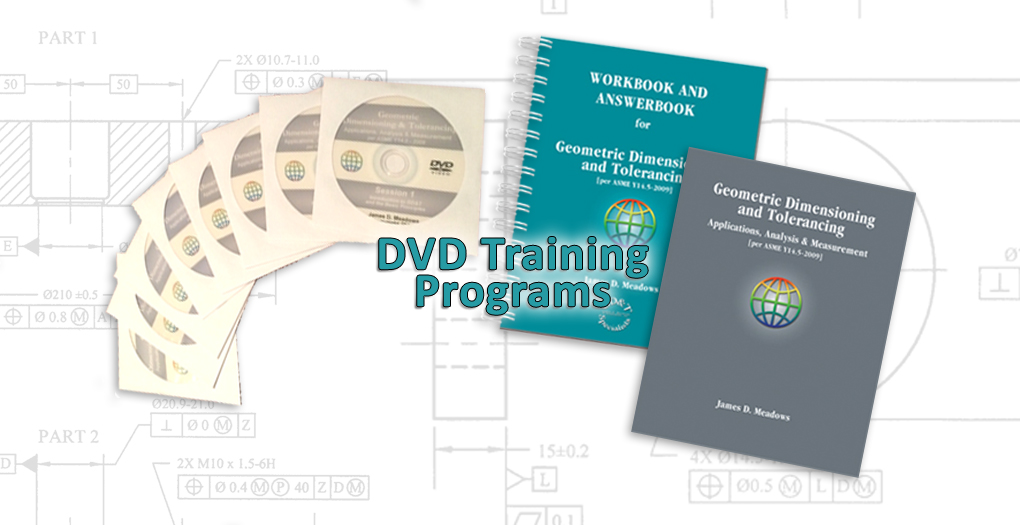
GD&T - Applications, Analysis & Measurement Training Series (per ASME Y14.5M-1994 and Y14.5-2009 and the differences between them)
Tolerance Stack-Up Analysis (for Plus and Minus and Geometric Tolerances)
Applications-Based GD&T DVD Training Series (per ASME Y14.5M-1994)
14 hours of training (12 DVDs)
- To take full advantage of the training, we recommend you also purchase the text and workbook used in the training presentation (course materials vary depending on which web-based series you are watching).
- Pause the lesson and work the reinforcement exercises, then turn the lesson back on to see how each problem is completed.
- Since the lessons build in complexity, we recommend you start with the first and follow through each successive lesson.
Purchase individual films or the entire series and download the videos to watch on your own time!
DOWNLOAD TO OWN (unlimited viewing, no burn) or 48-HOUR RENTAL
Click our FAQs to learn how it works!
If you have any questions about GD&T training, books, workbooks, tests or DVDs, please reach out to James D. Meadows & Associates, Inc., at (615) 924-3600, or email at jim@geotolmeadows.com